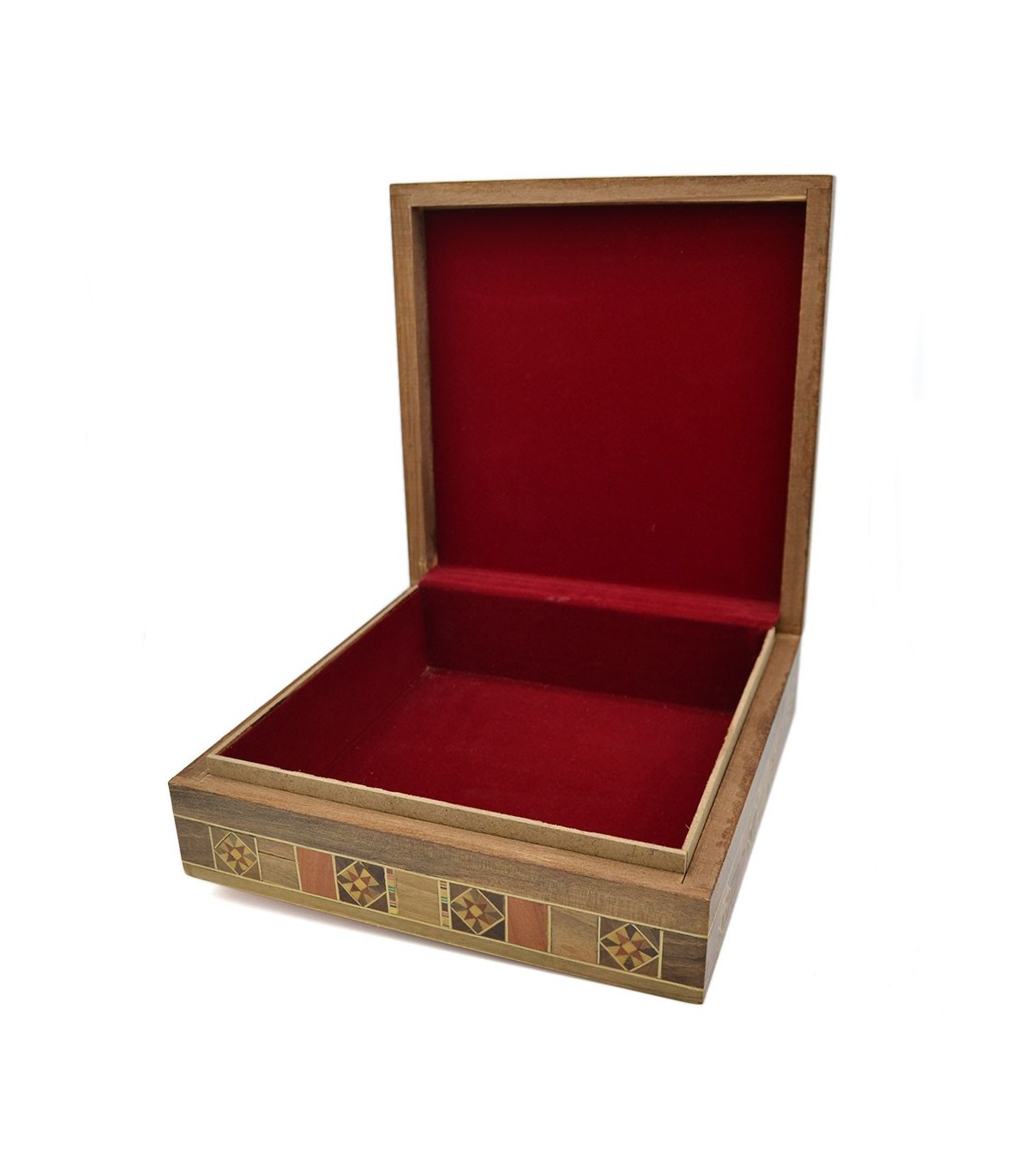
In Jaima Alkauzar you can Buy Online Inlaid square box from Syria decorated with mother-of-pearl, various types of wood. Athe best price.
More models availableHERE
Perfect gift, to include some detail inside. Perfect wooden box to give a special book.
External Measurements:
19.5cm x 19.5cm x 6cm
Inside:
16.5cm x 16.5cm x 4.5cm
The inlay technique refers to the veneering or inlay of fine sheets of precious wood, ivory or bone, mother-of-pearl or shells covering a wooden body.
It appears very early in history, in Mesopotamia, around 2600 BC, as evidenced by numerous objects found in the excavations of Ur).
Homer's Odyssey and Pliny the Elder name objects made using this technique. It was also known in pharaonic Egypt, and was perpetuated in the Coptic era and then in the Islamic one. . In particular, a set of tablets date from the beginning of the Islamic period. . They present a geometric decoration: a game of checkers and rhombuses associated with motifs of arcades and stylized columns. This precious looking decoration still bears the imprintof late antiquity. In the Fatimid period (10th-12th centuries), the motifs and style evolve.
It was in the twelfth century, under the Seljuk Atabegs and the Ayyubids, that inlaid woodworking developed considerably, mainly for the furnishings of religious buildings. Marquetry work, using ivory and mother-of-pearl, associated with finely carved wood, enhances the strictly geometric decoration of complex motifs centered around eight- or ten-pointed stars.
This association of complex geometric networks, built around star-shaped polygons and rich inlay work, will find its fullness in the Mamluk period, in the decoration of large pious foundations, . During the fourteenth century, there is sometimes an important use of large inlays of ivory elements.
In a more miniaturist style, furniture elements are made, such as the kursi and the Koran box in wood inlaid with ivory, bone, and precious woods.
At the same time, the Christians of Egypt also used this technique to decorate their churches.
The Ottoman Turks probably borrowed from the Mamluks the art of marquetry, since then reserved for furniture elements.
Wood marquetry was transmitted from the East to Italy, where it will receive the name of intarsia. The first mentions appear in documents found in Siena in ehe 13th century, where the use of ivory is privileged to obtain a strong bichrome contrast with the dark wood. From Italy, the marquetry will then spread throughout Europe.








 English
 Español
 Português PT
 Français
 Deutsch
 Italiano